Birk Janz
Menu
Work
About
Contact
Case
Billo
Designing trust in a digital mailbox for all your post.
Billo set out to create one place for every important document, whether it was delivered digitally or arrived as physical mail. By redirecting, opening and scanning paper mail, the service gave users access to bills, official letters and other important documents wherever they were. The ambition grew into a complete digital mailbox where users could read documents, connect a bank account, pay invoices and act on information directly from the app.
The core challenge was trust. Billo asked users to let an unfamiliar service handle sensitive documents, legal authorisation and financial information. Making that complexity feel safe and effortless became the central design challenge.
- Client: Billo , via NoA Ignite
- Year: 2021–2022
- Role: Digital Designer, leading UX and UI
- Platform: iOS, Android and Web
- Scope: Product Design, UX, UI, Design System, Prototyping & QA
My Contribution
I first contributed to Billo during my internship at NoA Ignite, creating concepts that became part of the material used during the company’s early fundraising. Once product development began, I joined the project from day one and gradually became the primary designer.
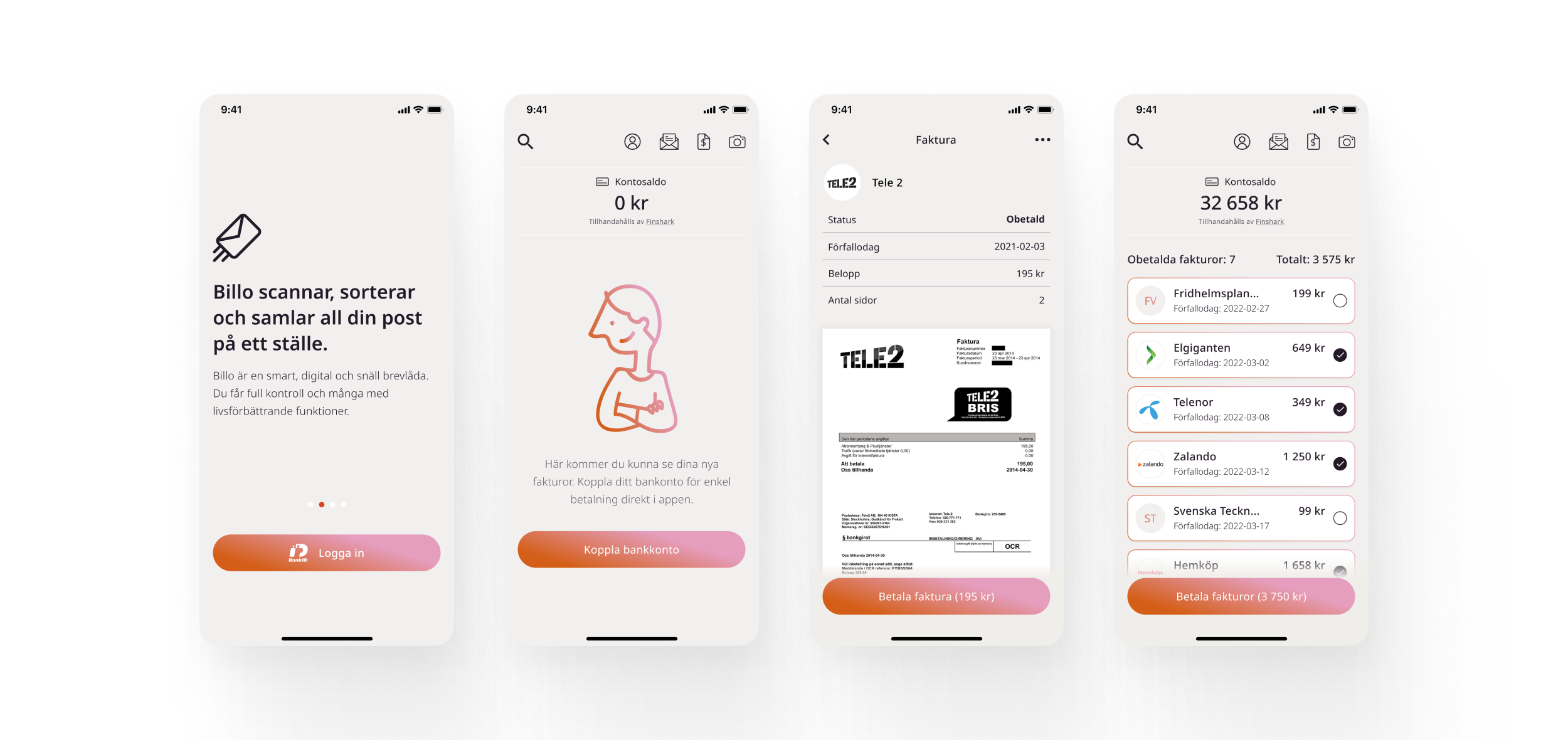
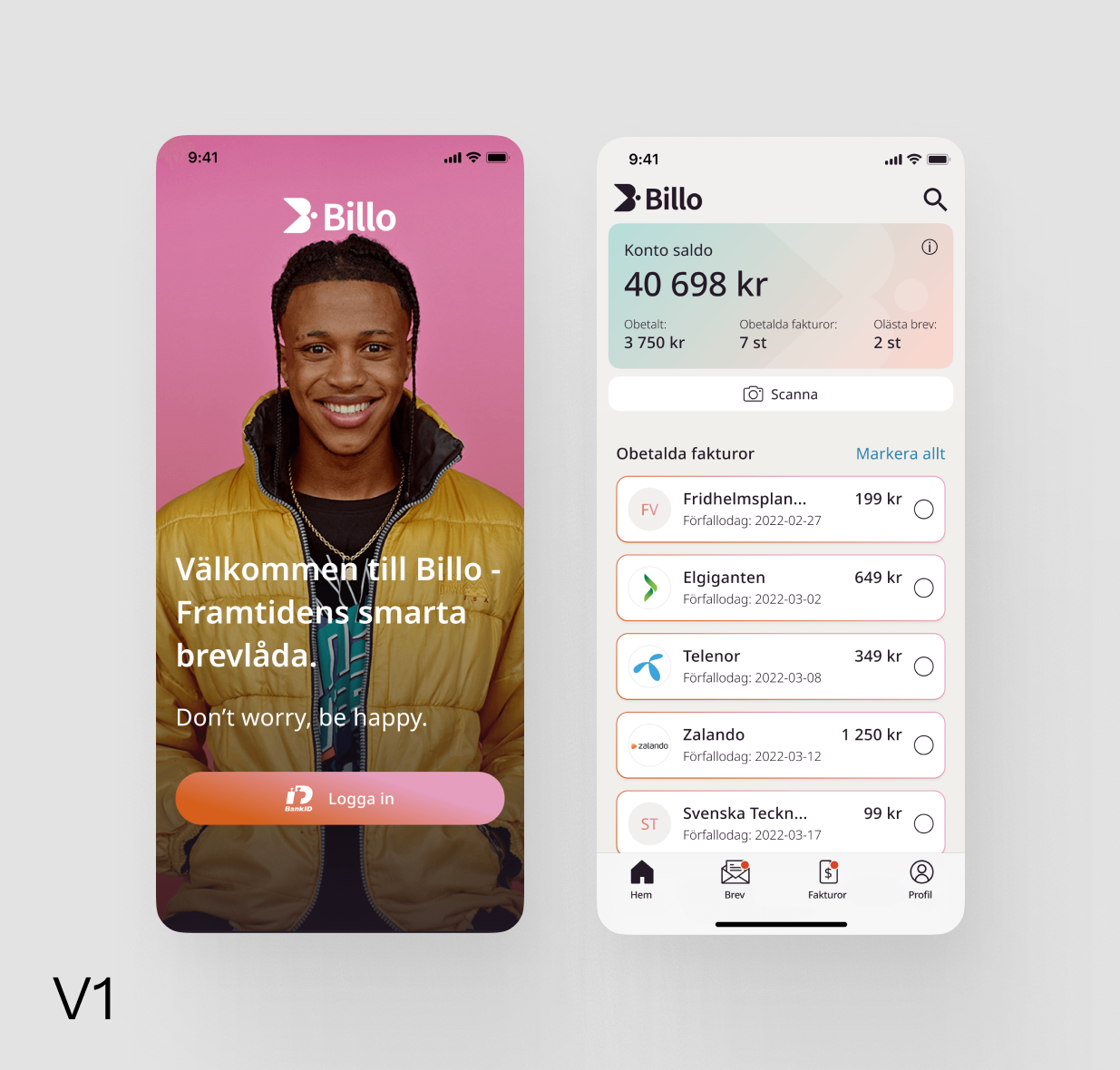
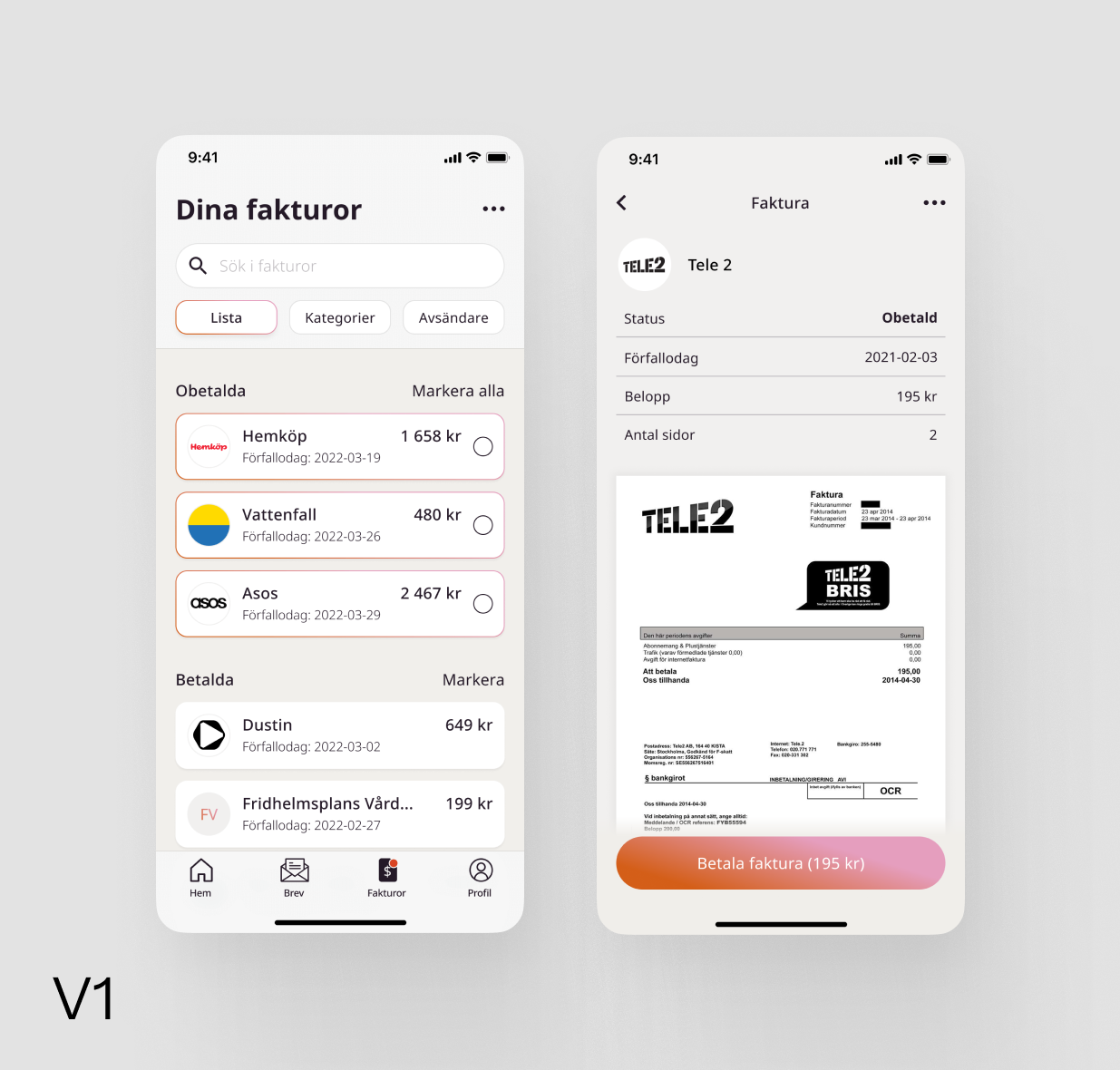
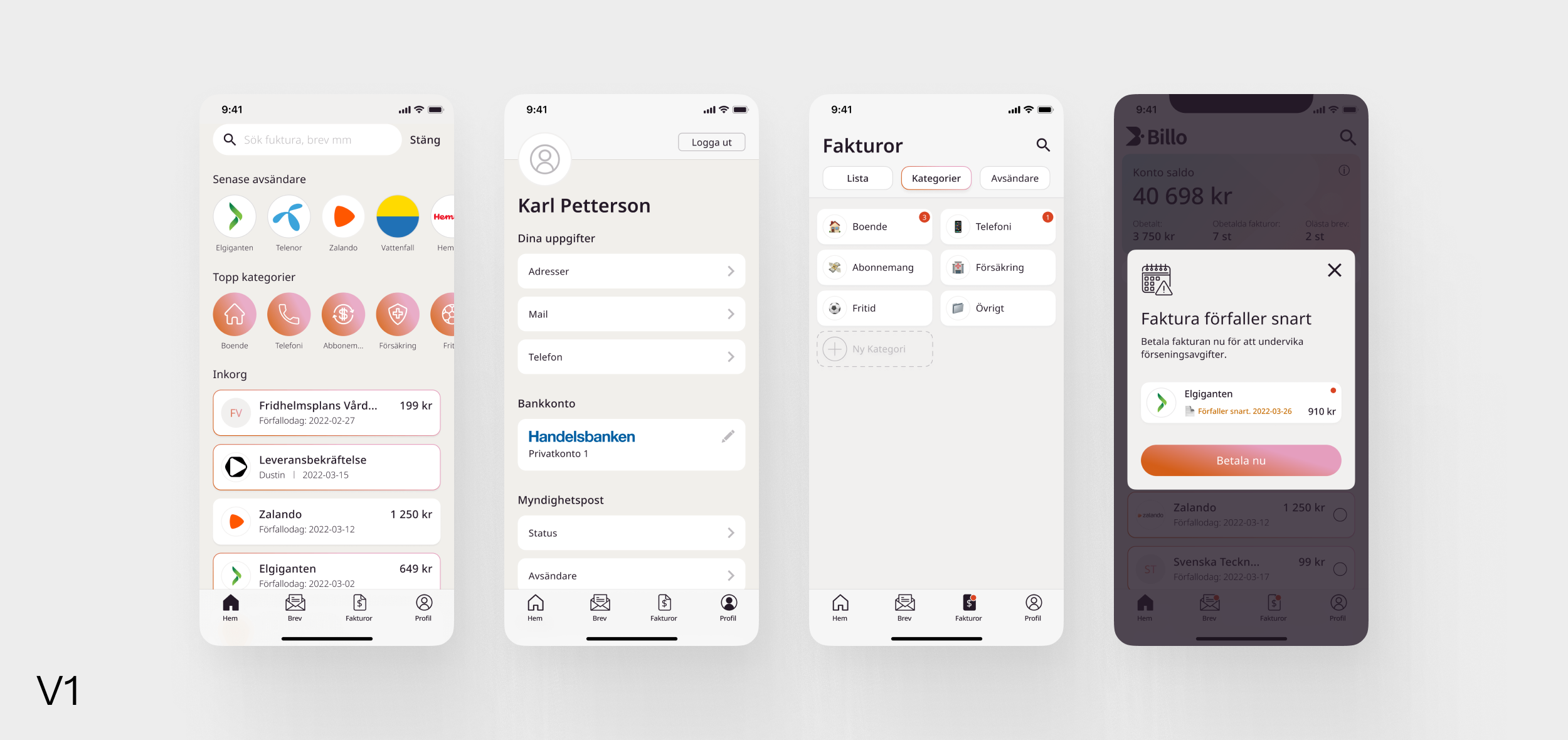
After a short initial setup alongside a senior designer, I took ownership of the UX and UI throughout the MVP and first native release. I designed the onboarding experience, BankID verification, bank account connections, document management, invoice payments, navigation and the supporting design system.
Working closely with product managers, system architects, backend engineers and mobile developers, I translated technically complex integrations into experiences that felt intuitive, reliable and easy to navigate.
Designing for Trust
The hardest part of the project was not explaining what Billo did. It was giving users enough confidence to let the service do it.
Some steps happened instantly, while others, such as processing a physical authorisation letter, could take several days. The experience therefore needed to make it consistently clear what was happening, whether the user needed to act and when Billo was safely handling everything in the background.
Clear status communication, short flows and continuous feedback helped users remain informed without making the service feel technical or overwhelming.
Key Design Decisions
Making inactivity feel valuable
One of the guiding principles was that Billo should feel calm when nothing required attention. Rather than filling the home screen with content, the experience clearly communicated when everything was under control. Notifications brought users back only when something actually required action.
A restrained interface, reassuring empty states and a slightly more approachable visual language helped the product feel calm without becoming cold or institutional. The result was what we internally described as calm emptiness—a product that reassured users by making it clear that everything was under control.
Designing around system states
Every document represented a different combination of information, actions and status. Instead of creating separate interfaces for every scenario, I designed flexible patterns that could adapt to different document types while maintaining consistency throughout the experience. Status indicators made it immediately clear whether something required attention, was being processed or had already been completed.
The goal was always to reduce cognitive load without hiding important information.
Moving from an MVP to a native product
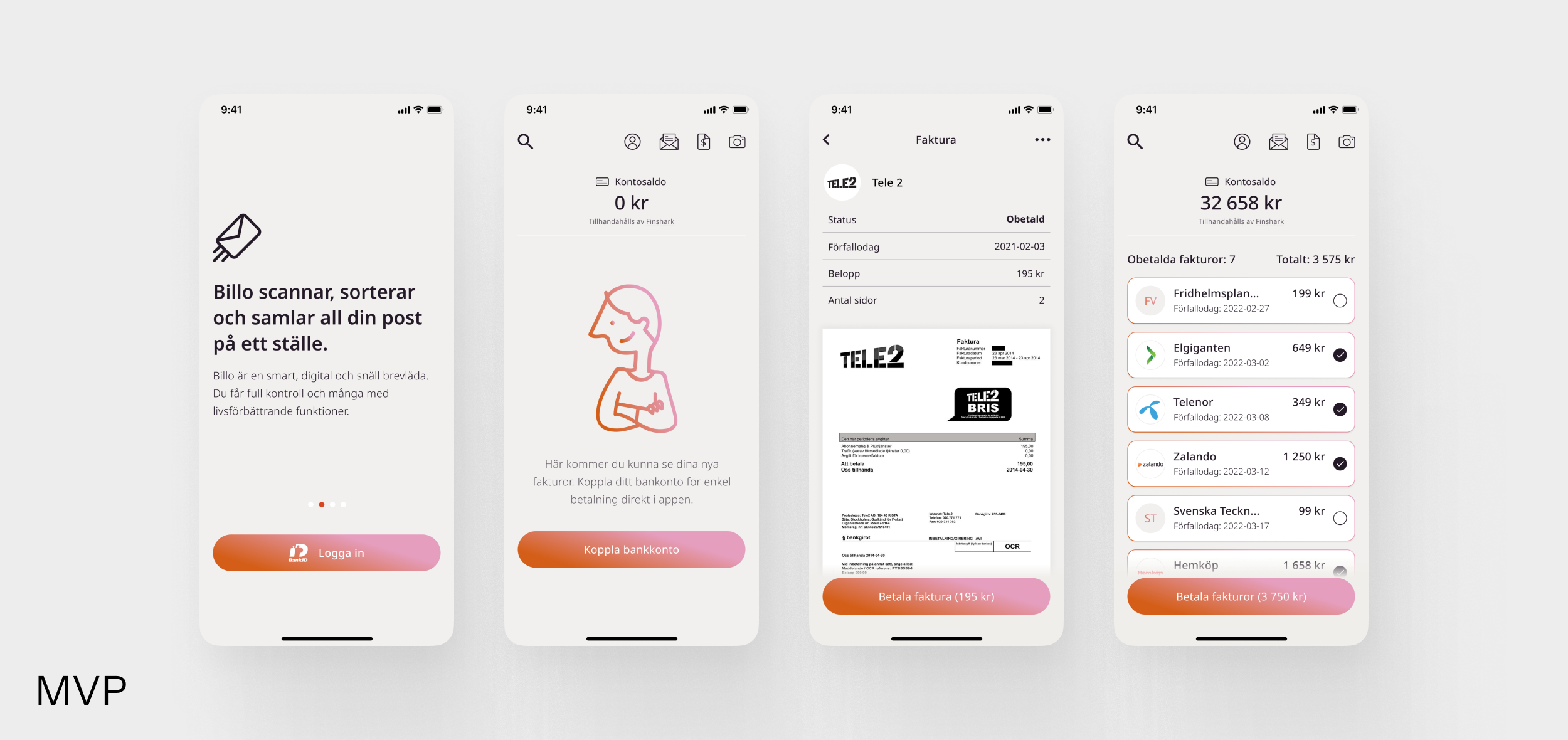
The first MVP was built in React Native to validate the concept quickly across iOS and Android. As the product matured, I advocated for redesigning the navigation around native platform conventions rather than preserving the original web-inspired structure.
Although it required revisiting several flows, the change resulted in a faster, more familiar and more trustworthy experience.
It was also an early lesson in confidently advocating for user-centred design decisions, even when stakeholders were initially attached to an existing solution.
Outcome
The project progressed from early investor concepts to a testable MVP and ultimately to Billo’s first publicly launched native product.
The released experience brought physical and digital post, identity verification, bank connections, document organisation and invoice payments into one coherent mobile product. Complex integrations and backend processes were translated into focused actions and clear system feedback.
The work established the product and design foundation that Billo’s internal team continued developing after the agency engagement.
Reflection
Billo was the first product I helped take from an early concept to a functioning, launched service. Taking on design ownership so early in my career taught me to look beyond individual screens and understand how product logic, system architecture, technical constraints and user trust shape the entire experience.
It also taught me the value of disciplined prioritisation and of confidently advocating for familiar, user-centred patterns when stakeholders are attached to an existing solution.
The lesson I still carry with me is simple: when a product handles something complex or sensitive, good design should make people feel informed, capable and in control.
Visuals
Located
StockholmSweden
CONTACT
birk.janz@gmail.com
SOCIAL
Birk Janz
Work
About
Contact
Case
Billo
Designing trust in a digital mailbox for all your post.
Billo set out to create one place for every important document, whether it was delivered digitally or arrived as physical mail. By redirecting, opening and scanning paper mail, the service gave users access to bills, official letters and other important documents wherever they were. The ambition grew into a complete digital mailbox where users could read documents, connect a bank account, pay invoices and act on information directly from the app.
The core challenge was trust. Billo asked users to let an unfamiliar service handle sensitive documents, legal authorisation and financial information. Making that complexity feel safe and effortless became the central design challenge.
- Client: Billo , via NoA Ignite
- Year: 2021–2022
- Role: Digital Designer, leading UX and UI
- Platform: iOS, Android and Web
- Scope: Product Design, UX, UI, Design System, Prototyping & QA
My Contribution
I first contributed to Billo during my internship at NoA Ignite, creating concepts that became part of the material used during the company’s early fundraising. Once product development began, I joined the project from day one and gradually became the primary designer.
After a short initial setup alongside a senior designer, I took ownership of the UX and UI throughout the MVP and first native release. I designed the onboarding experience, BankID verification, bank account connections, document management, invoice payments, navigation and the supporting design system.
Working closely with product managers, system architects, backend engineers and mobile developers, I translated technically complex integrations into experiences that felt intuitive, reliable and easy to navigate.
Designing for Trust
The hardest part of the project was not explaining what Billo did. It was giving users enough confidence to let the service do it.
Some steps happened instantly, while others, such as processing a physical authorisation letter, could take several days. The experience therefore needed to make it consistently clear what was happening, whether the user needed to act and when Billo was safely handling everything in the background.
Clear status communication, short flows and continuous feedback helped users remain informed without making the service feel technical or overwhelming.
Key Design Decisions
Making inactivity feel valuable
One of the guiding principles was that Billo should feel calm when nothing required attention. Rather than filling the home screen with content, the experience clearly communicated when everything was under control. Notifications brought users back only when something actually required action.
A restrained interface, reassuring empty states and a slightly more approachable visual language helped the product feel calm without becoming cold or institutional. The result was what we internally described as calm emptiness—a product that reassured users by making it clear that everything was under control.
Designing around system states
Every document represented a different combination of information, actions and status. Instead of creating separate interfaces for every scenario, I designed flexible patterns that could adapt to different document types while maintaining consistency throughout the experience. Status indicators made it immediately clear whether something required attention, was being processed or had already been completed.
The goal was always to reduce cognitive load without hiding important information.
Moving from an MVP to a native product
The first MVP was built in React Native to validate the concept quickly across iOS and Android. As the product matured, I advocated for redesigning the navigation around native platform conventions rather than preserving the original web-inspired structure.
Although it required revisiting several flows, the change resulted in a faster, more familiar and more trustworthy experience.
It was also an early lesson in confidently advocating for user-centred design decisions, even when stakeholders were initially attached to an existing solution.
Outcome
The project progressed from early investor concepts to a testable MVP and ultimately to Billo’s first publicly launched native product.
The released experience brought physical and digital post, identity verification, bank connections, document organisation and invoice payments into one coherent mobile product. Complex integrations and backend processes were translated into focused actions and clear system feedback.
The work established the product and design foundation that Billo’s internal team continued developing after the agency engagement.
Reflection
Billo was the first product I helped take from an early concept to a functioning, launched service. Taking on design ownership so early in my career taught me to look beyond individual screens and understand how product logic, system architecture, technical constraints and user trust shape the entire experience.
It also taught me the value of disciplined prioritisation and of confidently advocating for familiar, user-centred patterns when stakeholders are attached to an existing solution.
The lesson I still carry with me is simple: when a product handles something complex or sensitive, good design should make people feel informed, capable and in control.
Visuals
Located
StockholmSweden
CONTACT
birk.janz@gmail.com
SOCIAL
Birk Janz
Work
About
Contact
Case
Billo
Designing trust in a digital mailbox for all your post.
Billo set out to create one place for every important document, whether it was delivered digitally or arrived as physical mail. By redirecting, opening and scanning paper mail, the service gave users access to bills, official letters and other important documents wherever they were. The ambition grew into a complete digital mailbox where users could read documents, connect a bank account, pay invoices and act on information directly from the app.
The core challenge was trust. Billo asked users to let an unfamiliar service handle sensitive documents, legal authorisation and financial information. Making that complexity feel safe and effortless became the central design challenge.
- Client: Billo , via NoA Ignite
- Year: 2021–2022
- Role: Digital Designer, leading UX and UI
- Platform: iOS, Android and Web
- Scope: Product Design, UX, UI, Design System, Prototyping & QA
My Contribution
I first contributed to Billo during my internship at NoA Ignite, creating concepts that became part of the material used during the company’s early fundraising. Once product development began, I joined the project from day one and gradually became the primary designer.
After a short initial setup alongside a senior designer, I took ownership of the UX and UI throughout the MVP and first native release. I designed the onboarding experience, BankID verification, bank account connections, document management, invoice payments, navigation and the supporting design system.
Working closely with product managers, system architects, backend engineers and mobile developers, I translated technically complex integrations into experiences that felt intuitive, reliable and easy to navigate.
Designing for Trust
The hardest part of the project was not explaining what Billo did. It was giving users enough confidence to let the service do it.
Some steps happened instantly, while others, such as processing a physical authorisation letter, could take several days. The experience therefore needed to make it consistently clear what was happening, whether the user needed to act and when Billo was safely handling everything in the background.
Clear status communication, short flows and continuous feedback helped users remain informed without making the service feel technical or overwhelming.
Key Design Decisions
Making inactivity feel valuable
One of the guiding principles was that Billo should feel calm when nothing required attention. Rather than filling the home screen with content, the experience clearly communicated when everything was under control. Notifications brought users back only when something actually required action.
A restrained interface, reassuring empty states and a slightly more approachable visual language helped the product feel calm without becoming cold or institutional. The result was what we internally described as calm emptiness—a product that reassured users by making it clear that everything was under control.
Designing around system states
Every document represented a different combination of information, actions and status. Instead of creating separate interfaces for every scenario, I designed flexible patterns that could adapt to different document types while maintaining consistency throughout the experience. Status indicators made it immediately clear whether something required attention, was being processed or had already been completed.
The goal was always to reduce cognitive load without hiding important information.
Moving from an MVP to a native product
The first MVP was built in React Native to validate the concept quickly across iOS and Android. As the product matured, I advocated for redesigning the navigation around native platform conventions rather than preserving the original web-inspired structure.
Although it required revisiting several flows, the change resulted in a faster, more familiar and more trustworthy experience.
It was also an early lesson in confidently advocating for user-centred design decisions, even when stakeholders were initially attached to an existing solution.
Outcome
The project progressed from early investor concepts to a testable MVP and ultimately to Billo’s first publicly launched native product.
The released experience brought physical and digital post, identity verification, bank connections, document organisation and invoice payments into one coherent mobile product. Complex integrations and backend processes were translated into focused actions and clear system feedback.
The work established the product and design foundation that Billo’s internal team continued developing after the agency engagement.
Reflection
Billo was the first product I helped take from an early concept to a functioning, launched service. Taking on design ownership so early in my career taught me to look beyond individual screens and understand how product logic, system architecture, technical constraints and user trust shape the entire experience.
It also taught me the value of disciplined prioritisation and of confidently advocating for familiar, user-centred patterns when stakeholders are attached to an existing solution.
The lesson I still carry with me is simple: when a product handles something complex or sensitive, good design should make people feel informed, capable and in control.
Visuals
Located
StockholmSweden
CONTACT
birk.janz@gmail.com
SOCIAL
Birk Janz
Work
About
Contact
Case
Billo
Designing trust in a digital mailbox for all your post.
Billo set out to create one place for every important document, whether it was delivered digitally or arrived as physical mail. By redirecting, opening and scanning paper mail, the service gave users access to bills, official letters and other important documents wherever they were. The ambition grew into a complete digital mailbox where users could read documents, connect a bank account, pay invoices and act on information directly from the app.
The core challenge was trust. Billo asked users to let an unfamiliar service handle sensitive documents, legal authorisation and financial information. Making that complexity feel safe and effortless became the central design challenge.
- Client: Billo , via NoA Ignite
- Year: 2021–2022
- Role: Digital Designer, leading UX and UI
- Platform: iOS, Android and Web
- Scope: Product Design, UX, UI, Design System, Prototyping & QA
My Contribution
I first contributed to Billo during my internship at NoA Ignite, creating concepts that became part of the material used during the company’s early fundraising. Once product development began, I joined the project from day one and gradually became the primary designer.
After a short initial setup alongside a senior designer, I took ownership of the UX and UI throughout the MVP and first native release. I designed the onboarding experience, BankID verification, bank account connections, document management, invoice payments, navigation and the supporting design system.
Working closely with product managers, system architects, backend engineers and mobile developers, I translated technically complex integrations into experiences that felt intuitive, reliable and easy to navigate.
Designing for Trust
The hardest part of the project was not explaining what Billo did. It was giving users enough confidence to let the service do it.
Some steps happened instantly, while others, such as processing a physical authorisation letter, could take several days. The experience therefore needed to make it consistently clear what was happening, whether the user needed to act and when Billo was safely handling everything in the background.
Clear status communication, short flows and continuous feedback helped users remain informed without making the service feel technical or overwhelming.
Key Design Decisions
Making inactivity feel valuable
One of the guiding principles was that Billo should feel calm when nothing required attention. Rather than filling the home screen with content, the experience clearly communicated when everything was under control. Notifications brought users back only when something actually required action.
A restrained interface, reassuring empty states and a slightly more approachable visual language helped the product feel calm without becoming cold or institutional. The result was what we internally described as calm emptiness—a product that reassured users by making it clear that everything was under control.
Designing around system states
Every document represented a different combination of information, actions and status. Instead of creating separate interfaces for every scenario, I designed flexible patterns that could adapt to different document types while maintaining consistency throughout the experience. Status indicators made it immediately clear whether something required attention, was being processed or had already been completed.
The goal was always to reduce cognitive load without hiding important information.
Moving from an MVP to a native product
The first MVP was built in React Native to validate the concept quickly across iOS and Android. As the product matured, I advocated for redesigning the navigation around native platform conventions rather than preserving the original web-inspired structure.
Although it required revisiting several flows, the change resulted in a faster, more familiar and more trustworthy experience.
It was also an early lesson in confidently advocating for user-centred design decisions, even when stakeholders were initially attached to an existing solution.
Outcome
The project progressed from early investor concepts to a testable MVP and ultimately to Billo’s first publicly launched native product.
The released experience brought physical and digital post, identity verification, bank connections, document organisation and invoice payments into one coherent mobile product. Complex integrations and backend processes were translated into focused actions and clear system feedback.
The work established the product and design foundation that Billo’s internal team continued developing after the agency engagement.
Reflection
Billo was the first product I helped take from an early concept to a functioning, launched service. Taking on design ownership so early in my career taught me to look beyond individual screens and understand how product logic, system architecture, technical constraints and user trust shape the entire experience.
It also taught me the value of disciplined prioritisation and of confidently advocating for familiar, user-centred patterns when stakeholders are attached to an existing solution.
The lesson I still carry with me is simple: when a product handles something complex or sensitive, good design should make people feel informed, capable and in control.
Visuals
Located
StockholmSweden
CONTACT
birk.janz@gmail.com
SOCIAL